


Last Updated:
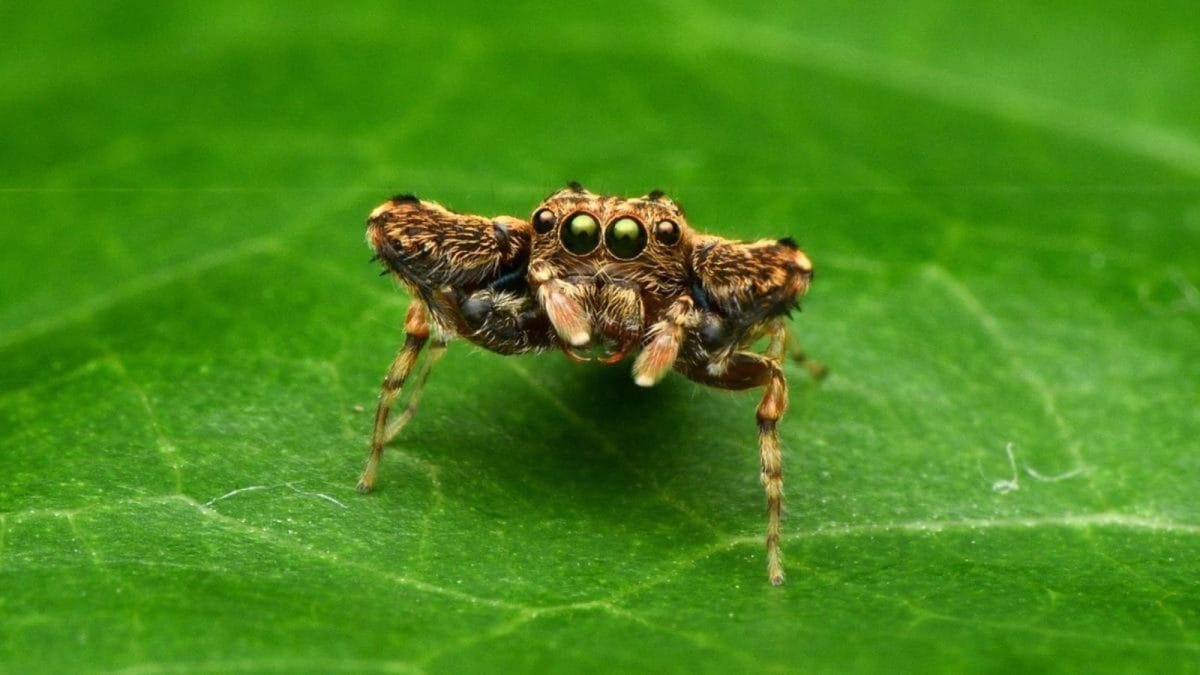
Pilia malenadu is a small but striking creature. As a member of the jumping-spider family, it is active in daylight hours, darting across leaves with that pause-and-hop rhythm.


That doubling of data – male and female specimens, allowed them to describe Pilia malenadu as a full species and provide much richer detail on its anatomy, behaviour and habitat (Image: X)
Nestled in the mist-draped hills of the Western Ghats near Mudigere in the Chikkamagaluru District of Karnataka, researchers have uncovered a quiet marvel: a species of jumping spider belonging to the little-known genus Pilia, now formally named Pilia malenadu.
The genus, established in 1902, had remained a mystery for over a century, its members known only from male specimens and largely absent from modern surveys. This discovery writes a new chapter not just for Indian arachnology, but for the biodiversity story of one of the planet’s richest ecosystems.
A century-old genus revived
The genus Pilia had been listed in taxonomic records but effectively forgotten in the field. Until now. When scientists ventured into the moist tropical forests of Malenadu – literally “rainy land” in Kannada, they collected not only male spiders of the genus but female ones too, for the first time ever.
That doubling of data – male and female specimens, allowed them to describe Pilia malenadu as a full species and provide much richer detail on its anatomy, behaviour and habitat.
Pilia malenadu is a small but striking creature. As a member of the jumping-spider family (Salticidae), it is active in daylight hours, darting across leaves with that typical pause-and-hop rhythm. Among its distinguishing features: thickened front-leg segments (femur, tibia) fringed with hair, and distinctive patches of dense hairs near its posterior lateral eyes, a trait absent in close relatives like the genus Bristowia.
In males, the reproductive palp carries a smooth bulb and a less prominent projection near the embolus compared to similar genera; the females show an epigyne with two round openings, long tube-shaped spermathecae and looping copulatory ducts. These are technical details but they underscore how every spider species, even one so small, carries deep evolutionary history.
Home in the green silence
Researchers observed Pilia malenadu in a very specific micro-niche: among the leaves of two plant species, Memecylon umbellatum and Memecylon malabaricum, within the forest canopy of Malenadu. Between January 2024 and March 2025 they documented 24 individuals (17 males, 3 females, 4 juveniles).
All sightings were during the day, between roughly 10 am and 5 pm on the undersides or sheltered gaps of leaves, suggesting a creature that prefers hush, shade and the safe spaces of its green world. One female was seen guarding her egg sac and newly hatched young, a rare encounter that gives us a glimpse into the life cycle of a genus otherwise lost to science.
Why this matters
There are several reasons this discovery is more than a footnote. First: it restores the genus Pilia to the map after 123 years. Second: the finding of female specimens finally fills a scientific missing piece and allows fuller taxonomic placement.
Third: it reminds us how much of the Western Ghats remains under-explored, even in a region increasingly mapped for roads, plantations and tourism. A tiny spider whispers of habitats still intact, micro-ecosystems still living and perhaps still fragile.
The wider ecological whisper
In the forests of Malenadu, Pilia malenadu lives among the green hush of evergreen and semi-evergreen trees, high rainfall, and steep slopes. These forests also face pressures: changing land use, plant-pathogen shifts, invasive species and the creeping edges of development.
The discovery reminds us that the remarkable biodiversity of the Western Ghats is not just in the big charismatic creatures but in the minute, the overlooked, the tucked-away. Each new species is a flag planted for conservation.
Taxonomists and ecologists will now ask: how widespread is Pilia malenadu? Is it confined to these Memecylon plants or will it turn up in neighbouring forest patches? What are the male-to-female ratios across seasons, the predation pressures, the genetic diversity?
And, crucially, what threats does it face? Given its narrow habitat and the pressure on forest tracts, the species could qualify for conservation focus even before a formal assessment is made.
A quiet tribute
The species name “malenadu” is more than a label. It is a nod to the region, its rains, its hills and its enduring forests. In Kannada, Malenadu conveys both “mountain land” and “rainy land,” and the name stitches together science, place and culture.
In naming it thus, the scientists paid respect to the land that harboured the spider, and to all the living webs that interlink forest, leaf, insect, and the micro-predator perched on a Memecylon leaf.
In a world that races toward skyscrapers, deep mines, and digital highways, the discovery of Pilia malenadu is an echo of how much still remains unseen, how much still holds quiet marvels in the shadows of leaves. The land may be hushed, but life in its lesser corners is still surprising, still delicate and still worth the pause.
November 05, 2025, 14:23 IST

Stay Ahead, Read Faster
Scan the QR code to download the News18 app and enjoy a seamless news experience anytime, anywhere.